

Written by: Paul Zygielbaum
ADAO Product Testing Project Manager
Last November 28, ADAO held a press conference at the National Press Club in Washington, DC, to present the first results of its tests of household consumer products for asbestos content. The event was well covered by US and Canadian news media, resulting in a flurry of news stories, reactions from industry and consumers, and government action.
The presentation was moderated by Doug Larkin, ADAO co-founder, and by Linda Reinstein, ADAO Executive Director and co-founder, who introduced the testing program to the press. Information on the testing and results was presented by Sean Fitzgerald, president of Scientific Analytical Institute, Inc. (SAI), an independent testing laboratory in Greensboro, NC. SAI had performed product testing and had managed confirmation testing subcontracted to two other independent laboratories as part of the project protocol. Following Fitzgerald’s presentation was a discussion of medical implications by Dr. Michael Harbut of the Karmanos Cancer Institue in Detroit, MI, who appeared via video link from his clinic.
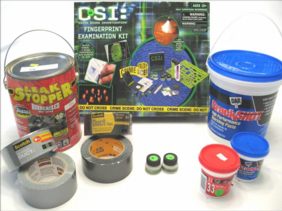
Five specific products were shown to the press, along with the test results revealing their asbestos content, as confirmed by all three laboratories. These products included:
• Planet Toys “CSI Fingerprint Examination Kit”
• DAP "33" window glazing
• DAP "Crack Shot" spackling paste
• Gardner Leak Stopper roof patch (which lists asbestos as an ingredient on the label)
• Scotch High Performance Duct Tape
Fitzgerald reported that SAI had tested over 250 different household products taken from retail shelves. The products had been selected as having some likelihood of asbestos content. Some list asbestos as an ingredient and were included in the study as a validation of test methodology. Of the 250 tested products, SAI found asbestos in 18. Of these, eight were confirmed by one of the other labs, and of these, the five products listed above were confirmed by all three labs.
Numerous media outlets carried the story immediately and in the following days. An exclusive story was published the morning of the press conference by Andrew Schneider of the Seattle Post-Intelligencer. Numerous television and radio news programs and newspapers picked up the story. Reinstein and Harbut were interviewed live by various networks over the next week.
ADAO observed stringent scientific standards in only reporting the five triple-confirmations at the press conference. However, concurrent with the press conference and out of concern for public safety, ADAO sent a full report on the project results, citing all 18 products tested positive by SAI, to the heads of the US Environmental Protection Agency and the US Consumer Product Safety Commission. A spokesperson for the CPSC gave a noncommittal response, questioning the validity of ADAO’s report. There was no immediate response from the EPA.
Reaction from the manufacturers was swift. Planet Toys and CBS, which licenses the “CSI” trademark to the distributor, denied asbestos contamination after checking with the toy’s Chinese manufacturer. Coming during the Christmas shopping season, the announcement about this toy caught the primary attention of the media, which focused at first on the toy’s Chinese origin. Only a few reports pointed out that such contamination is legal in the US. DAP and 3M (manufacturer of Scotch brand) also denied the presence of asbestos in their products.
However, ADAO’s report on the “CSI” kit was corroborated on December 19, when the State of Connecticut’s Department of Consumer Protection announced that, acting on news reports of ADAO’s testing, he had asked the state’s Public Health Department to perform testing on samples of the same toy, and that asbestos had been found in those samples. In announcing that his department was halting the sale of the toy within the state and would begin investigating Planet Toys’ failure to act on the information provided by ADAO, Consumer Protection Commissioner Jerry Farrell, Jr., said, “Given the potential health hazards associated with any asbestos contact, we are removing the item from sale immediately, and are asking consumers to take swift measures to make sure their children aren’t exposed to the product. There is no ‘safe’ level of asbestos.”
The news from Connecticut appeared to support the credibility of ADAO’s testing. CBS ordered Planet Toys to pull the product off the market and threatened to withdraw its trademark license.
Response by retailers around the country varied during this period. Many retailers reported that they were pulling the toy off their shelves, while others seemed to address the issue by putting the product on sale.
Announced during Congressional discussion of bills that would ban asbestos in the US, ADAO’s announcement garnered attention from some Congressional staff members, who noted the importance of the results and the program.
ADAO’s testing program, supported by private donations, is believed to be the only one of its kind in the world. The immediate focus of continuing work is to resolve differences in test results between the three laboratories. In this effort, priority is being given to household products and toys that tend to be used by homemakers and children, rather than to home repair or hobby products. This decision recognizes the overwhelming concern of the press and the public with these types of products. Further results will be announced as they are scientifically validated.
In the longer run, ADAO’s program has indicated that the presence of asbestos in products on American markets may be far more widespread than previously believed, because the mineral appears to be an inadvertent contaminant, rather than an ingredient, in most of the products in which it was found. Various types of asbestos fibers were identified in the different products, including the most deadly forms. The “CSI” fingerprint kit, for example, was found to contain tremolite, with some samples exhibiting 5% tremolite content.
ADAO’s press release, portions of the presentation materials and reports, and a video of the press conference are available on ADAO’s website.
The ADAO is a registered 501(c)(3) nonprofit volunteer organization.
The Asbestos Disease Awareness Organization
1525 Aviation Boulevard, Suite 318 • Redondo Beach • California • 90278 • 310.437.3886
www.AsbestosDiseaseAwareness.Org
Info@AsbestosDiseaseAwareness.Org
| Sign up for Important Updates and eNewsletters |

