
Register Today
Registration is required and will close on Wednesday, June 10, at 5:00 p.m. ET. All registered attendees will receive a unique Zoom link on Thursday, June 11, at 9:00 a.m. ET.
Posted on June 5, 2026

Asbestos at a Crossroads: The Legal, Regulatory, and Legislative Battle to End Asbestos Exposure
Courts • Congress • Consumer Products • Communities
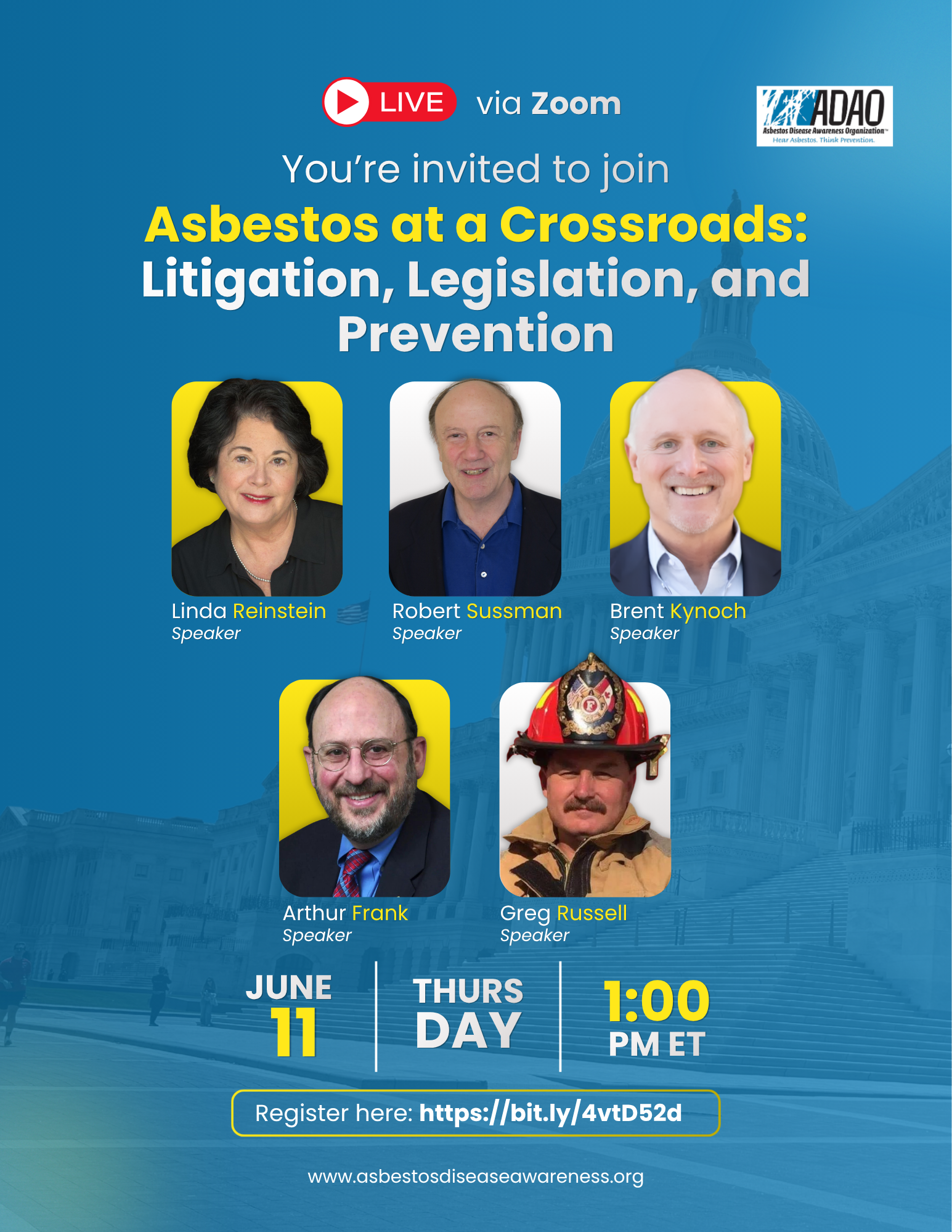
Despite decades of scientific evidence confirming that asbestos causes cancer and that there is no safe level of exposure, asbestos remains legal in the United States. Chrysotile asbestos continues to be used in industry. Legacy asbestos remains in millions of homes, schools, workplaces, and public buildings. Recent recalls of asbestos-contaminated children’s toys serve as a reminder that exposure risks continue.
At the same time, important decisions are being made in the courts, federal agencies, and Congress that will shape the future of asbestos prevention for years to come.
The U.S. Court of Appeals for the Fifth Circuit is reviewing EPA’s 2024 Chrysotile Asbestos Rule nearly 40 years after the same court overturned EPA’s 1989 asbestos ban. Major industry petitioners have withdrawn key challenges to the EPA’s scientific findings. EPA continues work on Part II of its asbestos risk evaluation, which addresses legacy asbestos and additional asbestos fibers. Meanwhile, Congress is considering the Alan Reinstein Ban Asbestos Now (ARBAN) Act, legislation that would finally ban all forms of asbestos.
The Science Is Settled. Exposure Continues. What Must Happen Next?
To address this challenge, the Asbestos Disease Awareness Organization (ADAO) will host a special webinar, Asbestos at a Crossroads: The Legal, Regulatory, and Legislative Battle to End Asbestos Exposure, on Thursday, June 11, 2026, at 1:00 PM ET.
This timely briefing will bring together leading experts in law, science, public health, labor, and advocacy to discuss the most significant asbestos developments of 2026 and the actions needed to finally end asbestos exposure.
Why This Webinar Matters Now
Several recent developments underscore why asbestos remains a current, not historical, public health issue:
- The Fifth Circuit is reviewing EPA’s Chrysotile Asbestos Rule nearly 40 years after overturning EPA’s 1989 asbestos ban.
- Major industry petitioners have withdrawn key challenges to EPA’s scientific findings.
- EPA’s Part II Risk Evaluation will shape how the nation addresses legacy asbestos.
- Recent recalls of asbestos-contaminated children’s toys demonstrate that exposure risks continue.
- Asbestos remains legal in the United States, making comprehensive legislation more important than ever.
Featured Speakers:
Linda Reinstein: 2026 Asbestos Developments: Why This Moment Matters
Robert Sussman: EPA’s Part I Chrysotile Asbestos Rule, EPA’s Part II Legacy Asbestos Risk Evaluation, and the Legal and Regulatory Future of Asbestos
Brent Kynoch: Legacy Asbestos, and the Next Regulatory Frontier
Dr. Arthur Frank: Asbestos in Children’s Toys and Consumer Products: What Recent Recalls Reveal About Ongoing Exposure Risks
Greg Russell: The Alan Reinstein Ban Asbestos Now Act: Why Congress Must Finish the Job
Despite decades of scientific evidence, ongoing litigation, legacy asbestos, continued imports, and recent recalls of asbestos-contaminated children’s toys, asbestos remains legal in the United States.
Join us as we examine the legal, regulatory, and legislative developments shaping the future of asbestos prevention and the actions needed to finally end asbestos exposure and protect future generations.
Register Today
Thursday, June 11, 2026 | 1:00 PM ET
Hosted by the Asbestos Disease Awareness Organization (ADAO)
Prevention Is the Cure.
2026 Sponsors: ADAO is grateful to our sponsors and supporters, especially our Platinum Sponsors: Dean Omar Branham Shirley, LLP and Simmons Hanly Conroy, LLP, Gold Sponsors: The Gori Law Firm and Motley Rice LLC, and Silver Sponsor Early, Lucarelli, Sweeney & Meisenkothen.
The Asbestos Disease Awareness Organization (ADAO), a registered 501(c)(3) nonprofit organization, does not make legal referrals.