

Posted on June 29, 2026
On August 31, 2026, the Center for Asbestos Related Disease (CARD) in Libby, Montana, will close after more than 25 years of serving one of the most heavily asbestos-exposed communities in the United States.
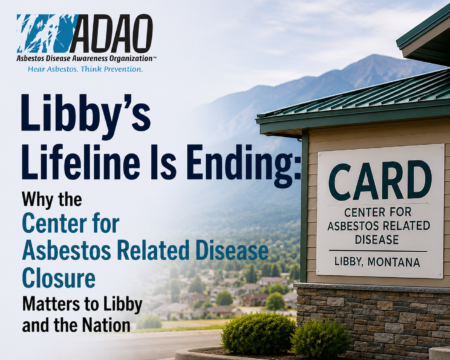

For thousands of current and former residents, this is far more than the loss of a medical clinic. It marks the end of a nationally recognized institution created in response to one of the worst environmental asbestos disasters in American history—a disaster whose health consequences continue today.
For more than two decades, the Asbestos Disease Awareness Organization (ADAO) has stood alongside the people of Libby, supporting patients and families, documenting their ongoing struggles, and advocating for stronger asbestos protections nationwide. CARD has been an indispensable partner, providing specialized expertise found nowhere else in the United States.
Although CARD is closing, Libby’s story is far from over.
The Disaster That Changed America’s Understanding of Asbestos
For decades, W.R. Grace & Company operated a vermiculite mine outside Libby. The ore was contaminated with tremolite asbestos, exposing not only miners but an entire community.
Workers unknowingly carried asbestos fibers home on their clothing. Children played on piles of contaminated mine waste. Schools, playgrounds, neighborhoods, and businesses became contaminated. Families installed vermiculite insulation in their homes without knowing it contained asbestos.
Libby transformed the world’s understanding of asbestos exposure. Once viewed primarily as an occupational hazard, asbestos was revealed to be a community-wide environmental threat affecting children, spouses, teachers, neighbors, and others with no workplace exposure.
More than 400 people have died from asbestos-related diseases in the Libby area, and thousands more have been diagnosed. Because these diseases often take decades to develop, new cases continue to emerge.
Libby’s impact also extends far beyond Montana. Vermiculite mined there was shipped throughout North America for use in homes, schools, and commercial buildings, leaving a legacy of potential exposure that remains today.
Recognizing the magnitude of the disaster, EPA declared Libby the nation’s first public health emergency resulting from an environmental disaster in 2009. Although cleanup of the Superfund site concluded in 2018, removing contaminated soil could never remove the asbestos fibers already inhaled.
Why CARD Became Essential
CARD was created because Libby’s needs were unlike those of any other community.
For more than 25 years, it became America’s leading community asbestos clinic—diagnosing asbestos-related diseases, monitoring exposed residents, coordinating specialized care, assisting patients with benefits, conducting free health screenings, and advancing scientific understanding of environmental asbestos exposure.
Its physicians, radiologists, nurses, researchers, and staff demonstrated that asbestos disease is not confined to factories and shipyards. Entire communities can be affected for generations.
CARD also became a trusted resource for former Libby residents who moved away but continued living with uncertainty about their past exposure.
As CARD Executive Director Tracy McNew stated:
“This community has helped change what is known about asbestos exposure, long-term community health needs, and public health response. CARD’s operations are coming to an end, but the impact of this work will continue.”
Why Is CARD Closing Now?
CARD’s closure did not result from a single event. It reflects years of legal, financial, and institutional challenges.
In 2023, BNSF Railway prevailed in litigation against CARD, resulting in a multi-million-dollar judgment that placed enormous financial strain on the organization. In 2025, the Lincoln County Sheriff’s Office seized the clinic’s building and assets while efforts continued to preserve patient services through federal funding.
Yet Libby’s story was—and remains—far from over. In April 2024, while CARD’s appeal was pending, a separate federal jury found BNSF Railway liable for contributing to two mesothelioma deaths. The verdict underscored that the health consequences of Libby’s asbestos contamination continue to affect workers, families, and the broader community decades after the original exposures.
Although a multi-year federal grant initially offered hope that CARD could continue serving Libby, that hope proved temporary. In June 2026, CARD announced that federal funding would not continue beyond the current budget year ending August 31, 2026. Without continued financial support, the organization concluded it could no longer operate.
The closure represents the loss of far more than a building. It marks the disappearance of more than 25 years of specialized medical expertise, scientific knowledge, and community trust developed in response to one of the nation’s most significant environmental asbestos disasters.
What Happens After August 31?
The consequences are immediate.
Patients are being encouraged to obtain copies of their medical records while staff remains available to assist with the transition. Long-distance screening programs have already ended, reducing access for former Libby residents living across the country.
Finding equivalent medical expertise will not be easy. Diagnosing asbestos-related diseases requires highly specialized knowledge developed over decades of clinical experience. CARD’s physicians and staff understood not only asbestos-related diseases, but also Libby’s unique exposure history and the challenges patients faced navigating healthcare, compensation systems, and federal benefits.
Although federal officials have begun exploring options to maintain access to care, recreating the expertise, continuity of care, and community trust CARD built over more than a quarter century will be extraordinarily difficult—if it can be replicated at all.
Why This Matters Beyond Libby
CARD’s closure raises important national questions about how America responds to communities harmed by toxic environmental exposures long after public attention fades.
Libby proved that environmental disasters do not end when contaminated soil is removed. Their health consequences continue for generations.
That lesson is especially important today as EPA develops regulations addressing legacy asbestos, asbestos-contaminated talc, and additional asbestos fiber types. Across the country, workers, families, first responders, and communities continue encountering asbestos during renovation, demolition, disasters, and in aging infrastructure.
Once asbestos fibers are inhaled, no cleanup can reverse the damage.
The Work Is Not Finished
For more than 25 years, CARD stood as a symbol of resilience, scientific progress, and compassionate care. Its work transformed the understanding of environmental asbestos exposure and improved the lives of thousands of patients and families.
Its closure should concern everyone who believes communities harmed by environmental contamination deserve long-term healthcare, accountability, and sustained public investment.
ADAO remains committed to ensuring that Libby’s hard-earned lessons are never forgotten.
One of those lessons is clear: America’s asbestos laws must address all dangerous asbestos fibers—not just chrysotile. The Alan Reinstein Ban Asbestos Now (ARBAN) Act would prohibit every federally regulated commercial form of asbestos, including the Libby amphibole fibers winchite and richterite, closing critical gaps in federal law and helping prevent future communities from suffering the same fate.
The mine closed. The cleanup ended. Now CARD is closing. But asbestos-related diseases will continue to emerge for decades.
The people of Libby have already paid an immeasurable price. Honoring their legacy requires more than remembering what happened. It requires ensuring that every American is protected from asbestos exposure and that no community is ever forced to endure another Libby.
NOTE: CARD is urging all patients to request their medical records immediately, as the post-closure request process is still being developed. With limited staff, processing requests before August 31 is a race against time. Patients can contact CARD at:
- In person: 118 W. 3rd Street, Libby, MT (Mon–Wed, 8 a.m.–5 p.m.)
- Phone: (406) 293-9274
~ Linda Reinstein
Related Reading
- ADAO Expresses Disappointment Regarding Verdict Reached in BNSF v. The Center for Asbestos Related Disease in Libby, Montana (2023)
- Unveiling the Environmental Tragedy: The W.R. Grace Contaminated Vermiculite Disaster and the Resilience of Libby, Montana (2023)
###
2026 Sponsors: ADAO is grateful to our sponsors and supporters, especially our Platinum Sponsors: Dean Omar Branham Shirley, LLP and Simmons Hanly Conroy, LLP, Gold Sponsors: The Gori Law Firm and Motley Rice LLC, and Silver Sponsor Early, Lucarelli, Sweeney & Meisenkothen.
The Asbestos Disease Awareness Organization (ADAO), a registered 501(c)(3) nonprofit organization, does not make legal referrals.