


Dedication: This briefing is dedicated to the first responders, workers, and residents of lower Manhattan lost to asbestos-related disease since 9/11.
Our Ask: Senate offices, cosponsor S.5235 (Merkley, Curtis). House offices, cosponsor H.R.5373 (Bonamici, Bacon). More than 50 countries ban asbestos. The United States has not.
Topics
- Health effects of asbestos and asbestos-related disease
- 9/11 at 25 years: exposure among responders, workers, and residents
- Current imports and uses, and legacy asbestos in schools, homes, and federal buildings
- EPA’s Part 1 chrysotile rule, the Fifth Circuit challenge, and the delayed Part 2 legacy rule
- The bipartisan Alan Reinstein Ban Asbestos Now Act
Speakers
- Brent Kynoch, Environmental Information Association
- Linda Reinstein, Asbestos Disease Awareness Organization
- Greg Russell, International Association of Fire Fighters
- Robert Sussman, JD, Counsel, Asbestos Disease Awareness Organization
Briefing Materials
- ADAO PRESS RELEASE: PUBLIC HEALTH AND SAFETY EXPERTS URGE CONGRESS TO PASS BIPARTISAN ASBESTOS BAN AT 20TH CONGRESSIONAL BRIEFING
- PowerPoint Presentation
- Briefing Speaker Biographies
- Briefing Executive Summary Notes
- ADAO Staff Briefing Blog
- Briefing Flyer
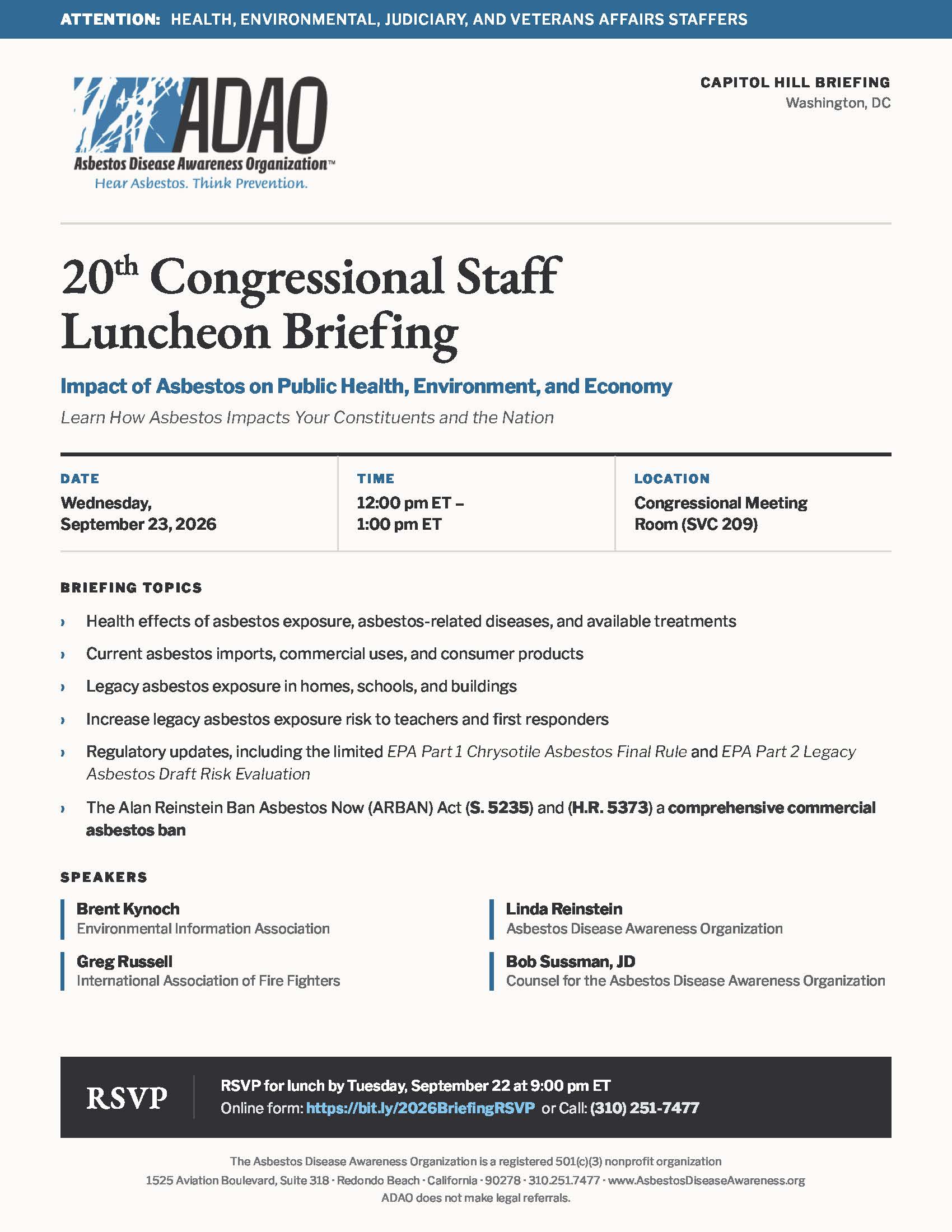
ARBAN Act
- 2026 ARBAN Update 2-Pager
- Merkley, Curtis Announce Bipartisan ARBAN Act of 2026 (August 4, 2026)
- ARBAN Resource Page and Timeline
- 2026 ARBAN Letters of Support
EPA and Litigation
- Part 1: EPA issued its chrysotile asbestos rule in March 2024. The Fifth Circuit heard Texas Chemistry Council v. EPA on June 1, 2026. ADAO defends the rule and seeks stronger protections.
- Part 2: EPA found unreasonable risk from legacy asbestos in December 2024 but missed its December 2025 deadline to propose a rule. It now targets June 2027. ADAO sued on April 21, 2026.
- ADAO timelines: Part 1, Part 2,
9/11 at 25 Years
- The US Centers for Disease Control and Prevention estimates that as many as 400,000 people were exposed. (CNN)
- Settled dust at Ground Zero contained 0.8 to 3.0 percent asbestos. Mesothelioma has appeared in lower Manhattan survivors 15 to 19 years after exposure (2024 study).
- In 2003, EPA’s Inspector General found EPA lacked sufficient data when it declared the air safe on September 18, 2001 (report).
- In September 2026, New York City released more than 170,000 pages of records showing officials knew of elevated asbestos results in late 2001 (PolitiFact, NYC 9/11 Document Portal).
- Residents, workers, and students, not only responders, may qualify for the World Trade Center Health Program and the Victim Compensation Fund, which accepts claims through October 1, 2090.
Studies, Stories, and Education
- 2026 USGS Mineral Commodity Summaries: Asbestos
- 2022 Lancet Oncology: Carcinogenicity of Occupational Exposure as a Firefighter
- 2019 data Over 40,000 American Workers Died from Preventable Asbestos-Caused Diseases
- 200+ Testimonies in the ADAO Share Your Story Collection
- ADAO Legacy Asbestos Safety Graphic: 5 Essential Tips